Most industries store their liquids using aboveground or underground tanks. To prevent corrosion and remove contaminant build-up, you need to empty and clean these tanks on a regular basis. At Hull’s Environmental Services, we offer storage tank cleaning and removal services for customers in Florida, Oklahoma, Georgia, Tennessee, and Texas.
Different Types of Underground and Aboveground Storage Tanks / Containers That We Clean
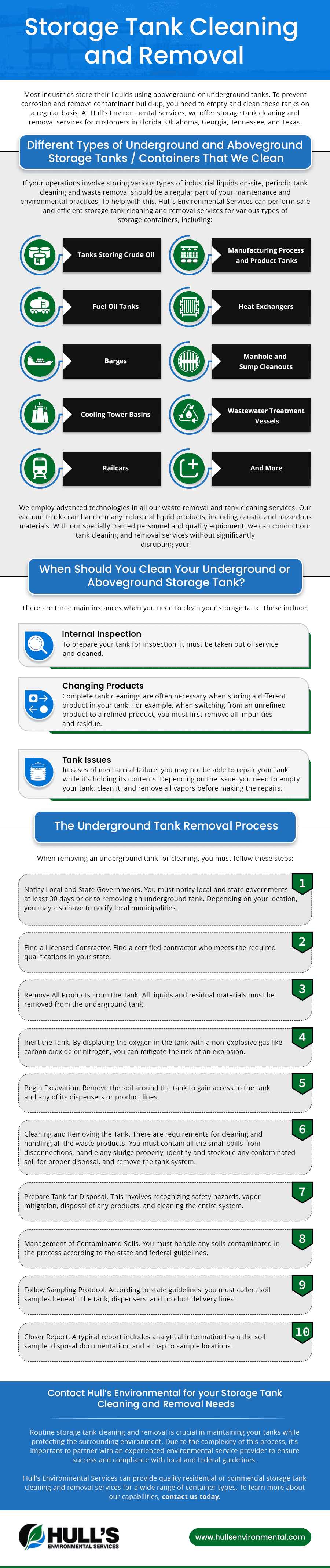
If your operations involve storing various types of industrial liquids on-site, periodic tank cleaning and waste removal should be a regular part of your maintenance and environmental practices. To help with this, Hull’s Environmental Services can perform safe and efficient storage tank cleaning and removal services for various types of storage containers, including:
- Tanks storing crude oil
- Manufacturing process and product tanks
- Fuel oil tanks
- Heat exchangers
- Barges
- Manhole and sump cleanouts
- Cooling tower basins
- Wastewater treatment vessels
- Railcars
- And more
We employ advanced technologies in all our waste removal and tank cleaning services. Our vacuum trucks can handle many industrial liquid products, including caustic and hazardous materials. With our specially trained personnel and quality equipment, we can conduct our tank cleaning and removal services without significantly disrupting your facility’s operations.
When Should You Clean Your Underground or Aboveground Storage Tank?
There are three main instances when you need to clean your storage tank. These include:
- Internal Inspection. To prepare your tank for inspection, it must be taken out of service and cleaned.
- Changing Products. Complete tank cleanings are often necessary when storing a different product in your tank. For example, when switching from an unrefined product to a refined product, you must first remove all impurities and residue.
- Tank Issues. In cases of mechanical failure, you may not be able to repair your tank while it’s holding its contents. Depending on the issue, you need to empty your tank, clean it, and remove all vapors before making the repairs.
The Underground Tank Removal Process
When removing an underground tank for cleaning, you must follow these steps:
- Notify Local and State Governments. You must notify local and state governments at least 30 days prior to removing an underground tank. Depending on your location, you may also have to notify local municipalities.
- Find a Licensed Contractor. Find a certified contractor who meets the required qualifications in your state.
- Remove All Products From the Tank. All liquids and residual materials must be removed from the underground tank.
- Inert the Tank. By displacing the oxygen in the tank with a non-explosive gas like carbon dioxide or nitrogen, you can mitigate the risk of an explosion.
- Begin Excavation. Remove the soil around the tank to gain access to the tank and any of its dispensers or product lines.
- Cleaning and Removing the Tank. There are requirements for cleaning and handling all the waste products. You must contain all the small spills from disconnections, handle any sludge properly, identify and stockpile any contaminated soil for proper disposal, and remove the tank system.
- Prepare Tank for Disposal. This involves recognizing safety hazards, vapor mitigation, disposal of any products, and cleaning the entire system.
- Management of Contaminated Soils. You must handle any soils contaminated in the process according to the state and federal guidelines.
- Follow Sampling Protocol. According to state guidelines, you must collect soil samples beneath the tank, dispensers, and product delivery lines.
- Closer Report. A typical report includes analytical information from the soil sample, disposal documentation, and a map to sample locations.
Contact Hull’s Environmental for your Storage Tank Cleaning and Removal Needs
Routine storage tank cleaning and removal is crucial in maintaining your tanks while protecting the surrounding environment. Due to the complexity of this process, it’s important to partner with an experienced environmental service provider to ensure success and compliance with local and federal guidelines.
Hull’s Environmental Services can provide quality residential or commercial storage tank cleaning and removal services for a wide range of container types. To learn more about our capabilities, contact us today.