The health and vitality of our communities and the environment require us to tackle the complexities of environmental contamination with safe and effective solutions. Hull’s Environmental Services is a trusted partner in the complex world of remediation, restoration, and redevelopment of contaminated sites.
Remediation, Restoration, and Redevelopment
Our expertise lies in the remediation of contaminated sites using a variety of approaches. We work with businesses to develop remedial action plans that minimize liability, cost, and exposure while maximizing cleanup effectiveness and restorative measures. Rooted in the post-cleanup process of emergency spill response, we’ve managed the remediation of hundreds of sites contaminated by oil, fuel, caustics, PCBs, solvents, and other contaminants through projects that range in size, scope, cost, and duration.
Our team can complete your next remediation project with a goal-oriented, task-driven approach or provide a turnkey solution integrating project planning, methodology, remedial activities, waste transportation, waste disposal, monitoring, and final closure.
What Are Environmental Remediation Services?
Environmental remediation refers to efforts aimed at removing contaminants from the environment (e.g., groundwater, surface water, and soil) following a catastrophic environmental event (e.g., an oil spill) or years of pollution. It is often instigated by government or regulatory agencies with the intent of protecting people from the effects of exposure to the contaminants and/or minimizing the spread of contaminants to surrounding environments.
Environmental Remediation Strategies
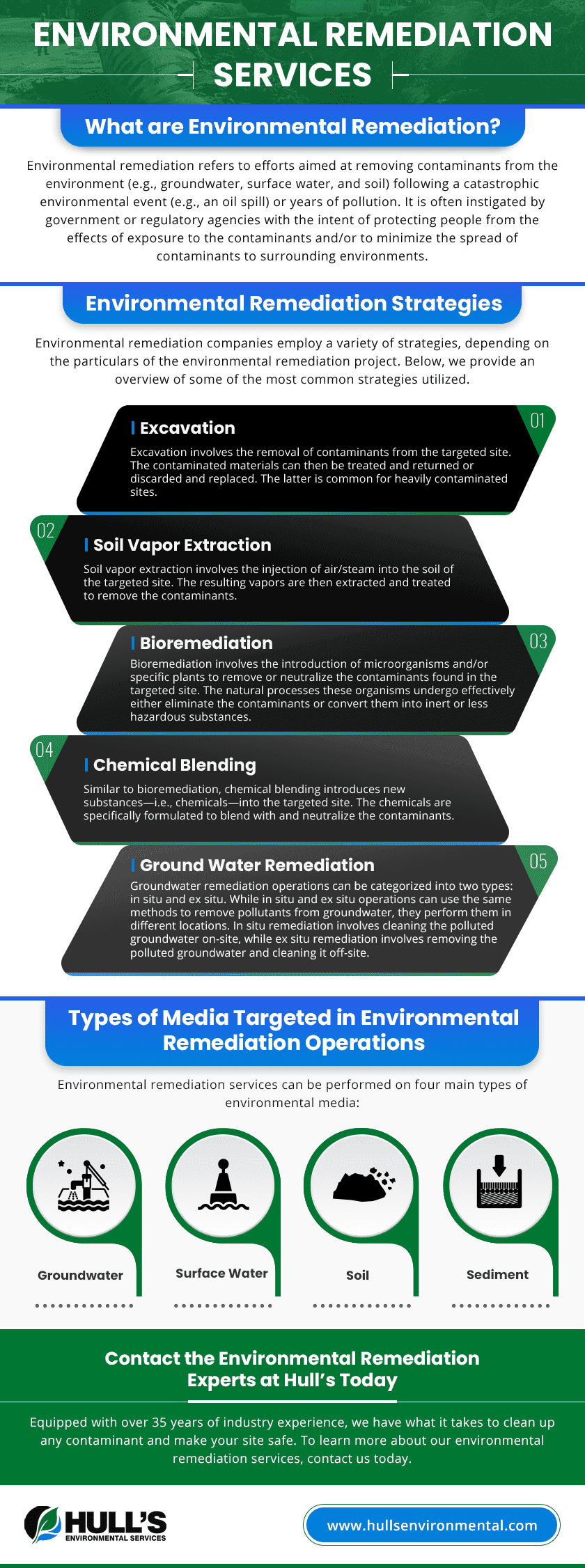
Environmental remediation companies employ a variety of strategies, depending on the particulars of the environmental remediation project. Below, we provide an overview of some of the most common strategies utilized.
Excavation
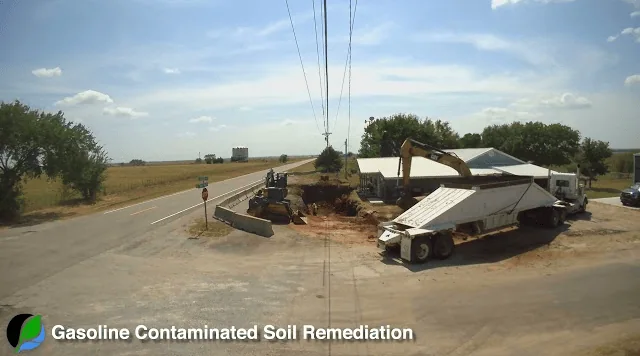
Excavation involves the removal of contaminants from the targeted site. The contaminated materials can then be treated and returned or discarded and replaced. The latter is common for heavily contaminated sites.
Soil Vapor Extraction
Soil vapor extraction involves the injection of air/steam into the soil of the targeted site. The resulting vapors are then extracted and treated to remove the contaminants.
Bioremediation
Bioremediation involves the introduction of microorganisms and/or specific plants to remove or neutralize the contaminants found in the targeted site. The natural processes these organisms undergo effectively either eliminate the contaminants or convert them into inert or less hazardous substances.
Chemical Blending
Similar to bioremediation, chemical blending introduces new substances—i.e., chemicals—into the targeted site. The chemicals are specifically formulated to blend with and neutralize the contaminants.
Groundwater Remediation
Groundwater remediation operations can be categorized into two types: in situ and ex-situ. While in situ and ex situ operations can use the same methods to remove pollutants from groundwater, they perform them in different locations. In situ remediation involves cleaning the polluted groundwater on-site, while ex situ remediation involves removing the polluted groundwater and cleaning it off-site.
Types of Media Targeted in Environmental Remediation Operations
Environmental remediation services can be performed on four main types of environmental media:
- Groundwater. Groundwater contamination can stem from a variety of surface-based operations and events, including agricultural activities, chemical, and industrial spills, and landfill leaks.
- Surface water. While surface water contamination is easier to deal with than groundwater contamination since it is easier to access, it generally involves harsher chemicals. As such, quick remediation is necessary to avoid severe consequences.
- Soil. Sources of soil contamination include agricultural runoff, chemical spills, and industrial waste disposal. Contaminated soil can be treated by soil vapor extraction, bioremediation, and chemical blending. However, it is best to remove and replace soil completely in severe cases.
- Sediment. Sediment is an umbrella term encompassing soil, sand, organic compounds, and other material found at the bottom of a body of water. Due to its location, it can collect and contain high levels of contaminants, which can lead to severe environmental risks.
Benefits of Environmental Remediation
As mentioned above, environmental remediation efforts are often initiated by government bodies or regulatory agencies. Aside from meeting these demands, investing in environmental remediation carries a number of benefits, including:
- Enhancing the quality of previously developed land. Brownfield land refers to land that is currently unused but was previously used and may contain contaminants or pollutants that make it unsafe to use. Environmental remediation allows these sites to be brought to a state where it can be used safely.
- Improving human health. Environmental contamination can have a severe negative impact on human health. Removing or neutralizing contaminants through environmental remediation reduces the risk of humans being exposed to hazardous compounds and developing illnesses or suffering injuries.
- Boosting ecosystems. Improving the quality of an environment benefits the plants, animals, and people residing in it.
- Reducing material damage. Reducing contaminant levels in the soil and groundwater can reduce the damage experienced by equipment, buildings, and other structures that come into contact with the environmental media.
- Improving aesthetics. Remediated environments look and smell better.
- Delivering continuing support. Even after a remediation job is finished, remediation teams can provide advice, testing, and evaluation services to ensure the site continues to be safe for use.
Environmental Remediation Services at Hull’s Environmental Services
Hull’s Environmental Services offers the following environmental remediation services:
- Brownfields Remediation
- Coal Combustion Byproduct (Fly Ash) Management
- Contaminated Soil Excavation
- Dredging/Sediment Remediation
- Environmental Containment
- Environmental Restoration
- Facility Decontamination/Demolition
- Hazardous Waste Management
- Landfill Cell Cap & Construction
- MGP Site Restoration
- PCB Testing, Removal, & Remediation
- Pit, Pond, and Lagoon Closure
- Soil Stabilization, Solidification, and Mixing
- UST/AST Tank Removal
- Vacuum Excavation & Extraction
Supporting Environmental Engineering & Consulting Firms
Hull’s Environmental Services supports environmental engineering and consulting firms that contract with government and industry to conduct large-scale, multi-site, and complex remedial projects that require an environmental contractor with vast remediation experience, heavy equipment, financial stability, and a commitment to health, safety, and the environment.
Contact the Environmental Remediation Experts at Hull’s Today
Looking for a partner for your remediation, restoration, and/or redevelopment project? Turn to the experts at Hull’s Environmental Services. Equipped with over 35 years of industry experience – and locations throughout Florida, Texas, Tennessee, Georgia, and Oklahoma – we have what it takes to clean up any contaminant and make your site safe. Get in touch to learn more about our environmental remediation services.